
What is my Sustainable Competitive Advantage?
What is my Sustainable Competitive Advantage?
Do you remember starting that big project, you know the one, it had high hopes of success, but it soon withered away, lost momentum and then ended in failure. Ouch!
According to Professor Bent Flyvbjorg and Dan Gardner – authors of the book ‘How Big Things Get Done’ and in their study of over 16,000 projects only 8.5% of projects hit their targets on time and on budget. Read that again – 8.5%!!! WOW!! They refer to it as the Iron Law – over budget, over time under benefits – time and time again.
The question we then need to ask is Why?
The authors discuss two ‘Root Causes’ of why projects fail to deliver the expected outcomes.
Root Cause Number 1 – Psychology and how the human brain works in terms of bias and which is dominated by optimism and over confidence.
Root Cause Number 2 – Power – our ability to make a project look attractive on paper by underestimating costs, underestimating the schedule, and overestimating the benefits, will help get the support needed to get the project over the line.
Several years ago, I was asked to facilitate an Apollo Root Cause Analysis investigation into a company’s Project Management framework, because in the previous three years every project had overspent the budget and failed to be completed on time. The investigation found over 60 cause and effects into the problem. Issues such as inexperienced project planners, insufficient funding, no detailed work scope, no contractor supervision, schedule of rates not agreed etc. All of which resulted in the Iron Law as mentioned above.
So why do we hear time again that ‘Reliability Project XYZ’ failed to deliver, or we tried to implement “Reliability” years ago and when the consultant and their team left, everything returned to normal….etc.
Does this sound familiar?
Imagine if we treated Production as a project, or Maintenance……or even Safety!! Yes, what would be the outcome if we treated Safety as a project? I think you would agree that the results would be unacceptable.
Personally, I have witnessed reliability improvement projects that have had mixed success in meeting the deliverables, but the ones with the greatest success are those that have treated reliability improvement as a journey of Culture development and not as a Project. Projects fail over 90% of the time.
So, if we are going to make Reliability truly Sustainable, the first thing we need to do is stop treating it like a project. Now.
If we want a sustainable competitive advantage we need to make Reliability a culture, just like safety.
Yes, to get things up and running we will need some benchmarking and a roadmap, to determine focus, but this is a journey, not a plan with a finish date, there is no end, it becomes part of the continuous improvement cycle within the organisation.
At PRS we have identified five key elements of what is required to embed Reliability as a Culture. We refer to them as the 5A’s. So here they are:
- Alignment – Mindset Alignment
There is an aligned mindset across the entire organization. A clear line of site is established throughout the business
- Agreement – Board Buy in
The board has bought in, gap to potential and value proposition is understood, strategy is agreed and every level is engaged with reliability. Targets are set.
- Adopt – Engage Everyone
Reliability is made available for everyone. Knowledge sharing and skills development is companywide. Teams are trained and in place. Reliability coaching is happening.
- Apply – Grow your Culture
A reliability improvement roadmap is in place, resources and systems are available, roles and responsibilities are clear. Implementation is underway.
- Advance – Reliability for Life
Reliability has become part of everyday life both formally and informally across the organisation. Measure and improve. Culture support structures are in place
By integrating these elements into the organisational fabric you can establish a Sustainable Reliability Culture that promotes efficiency, minimises downtime, and contributes to a reliable and sustainable future that the organisation can be proud of.
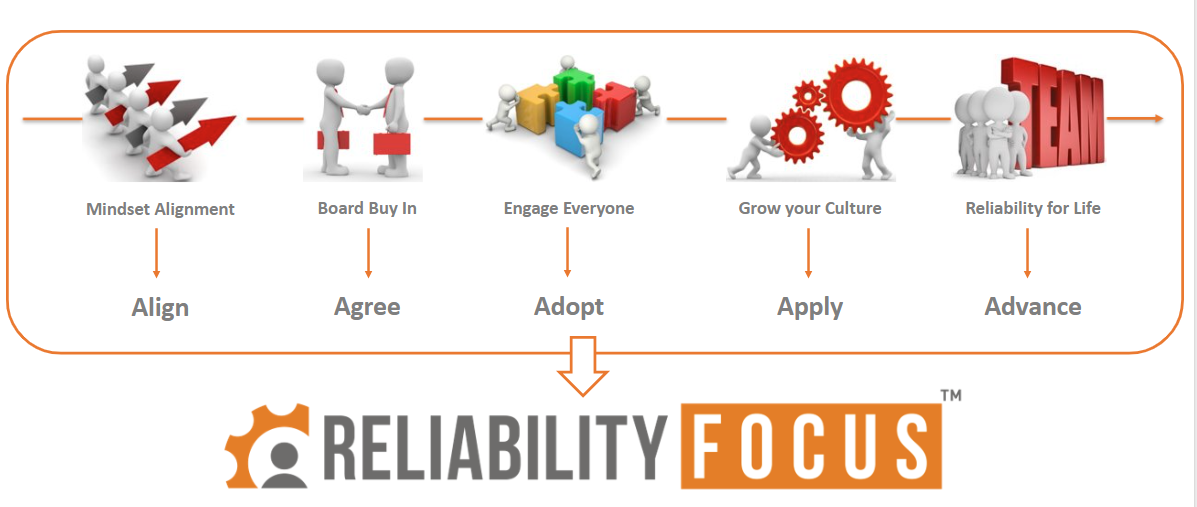
At PRS we have brought all these elements into a framework called ReliabilityFocus™.
It all starts with a ReliabilityFocus™ Maturity Assessment. This helps establish a line in the sand, a benchmark from which we can identify the ‘Gap to Potential’
When was the last time you performed a maturity assessment?
At a recent Manufacturing and Lean Conference 63% of companies attending indicated they had not carried out a Reliability Maturity Assessment in three years. This would suggest that the store of hidden profit in many businesses remains unknown, untapped, and costing business dearly.
If you would like to turn your ‘Reliability’ into something ‘Sustainable’, and provide you with a competitive advantage, then please do get in touch with the author of this article. We would be happy to discuss the approach further.
Sign up to our Newsletter!
Get the latest insights and news regarding Reliability Excellence directly into your mailbox every month by signing up below to our newsletter.
Feeling inspired after reading?
Why not join our growing community at our Reliability Hub page where you will get tools, tips and guidelines to help you on your Reliability Excellence journey.
Get the latest updates on courses and events before anyones else!
The Issue We Keep Seeing. In many HAZOP studies, particularly in asset-intensive industries, risk mitigation…
40 Years, 40 Lessons by Gary Tyne 40 Years, 40 Lessons is a compelling and…
What is my Sustainable Competitive Advantage? Do you remember starting that big project, you know…
Interested in our free Reliability Maturity Assessment?
Get in contact with our team today to start your journey to ensuring reliability and driving excellence